

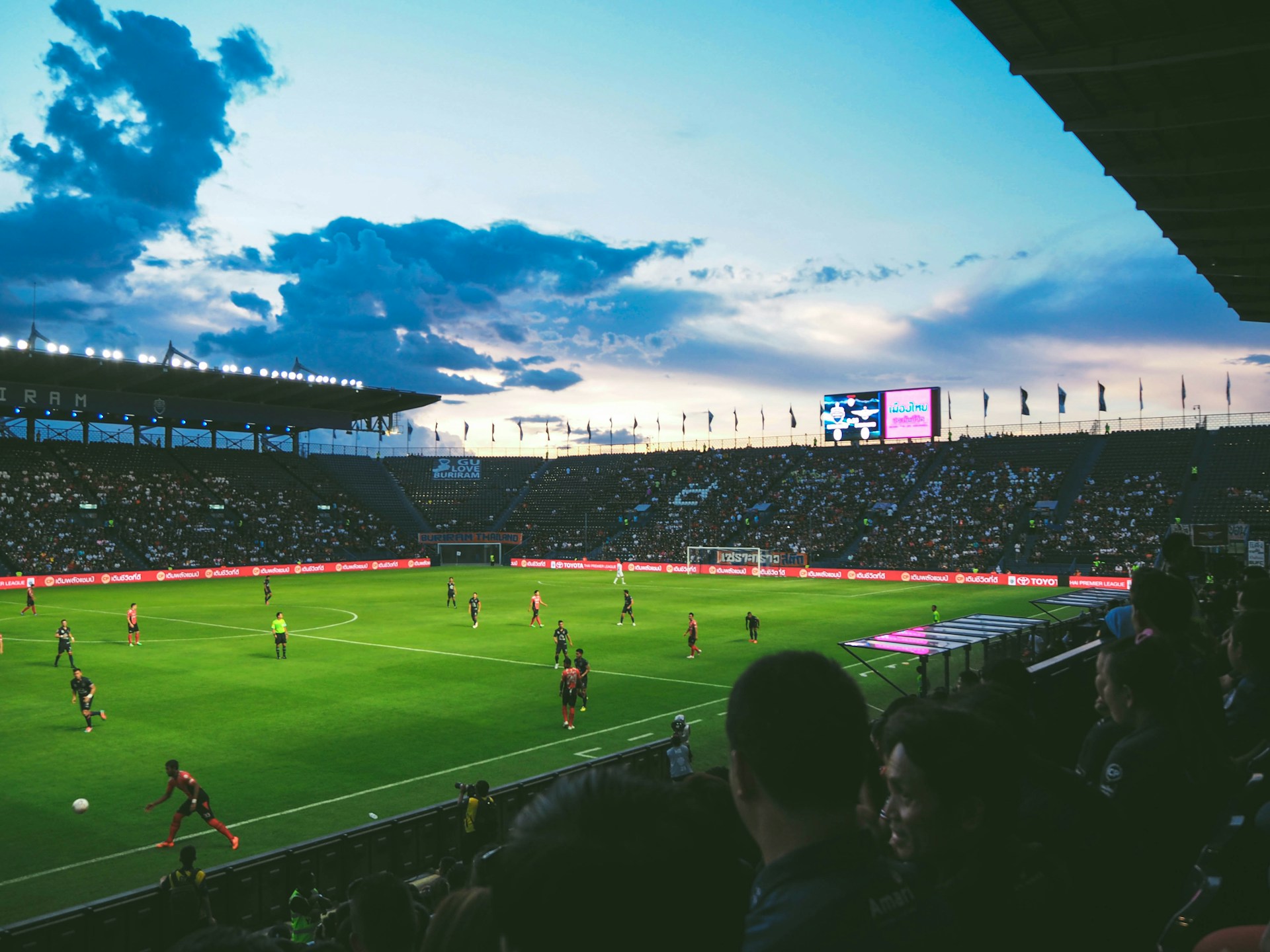
Football is a simple game, 22 people on a patch of grass attempt to kick a three dimensional circle into a net for 90 minutes and whoever does it the most times wins. The sport has been played in England since 1888, with 92 professional teams and hundreds more semi-professional and amateur teams dotted around the United Kingdom.
The sport creates value and is also expensive for the everyday person. Manchester United, the most valuable football team in the country and worth around $6.6 billion (around £4.8 billion), charge fans up to £1100 for a season ticket. All this information begs the question, why do we care so much about football? Why do people pay all this money to travel up and down the country watching their favourite athletes kick a ball around on a cold Tuesday night in Stoke?
Football is seen as more than a sport. The UK Government keeps an official record of football related violence in the UK and in the 24/25 football season over 1700 arrests were made at football matches up and down the country. Statistics such as this show that people see football as more than just a simple sport; it garners emotional reactions out of people that other forms of entertainment do not. You don't see people fighting over Strictly Come Dancing.
So, why does football induce such emotional reactions out of people that eventually lead to violence? It is not the entertainment of the sport that leads to this, it is the representation of a community on a national scale.
One of the most infamous rivalries in British football takes place in Glasgow, between Rangers and Celtic. They are a good example of why football means more than sport. The rivalry, nicknamed ‘The Old Firm’, encompasses history, politics, religion and cultural aspects. In his 2005 book Football Against The Enemy Simon Kuper explains the historical background behind the ‘Old Firm Derby’, stating how Rangers Football Club and their fanbase have stemmed from Irish Protestant communities who moved to Glasgow, while Celtic originated from Irish Catholics who fled to Scotland during the famine in Ireland.
These two distinct communities are apparent in the identities of the clubs. Rangers wear a blue kit, have a lion on their badge, and British flags can be spotted around their home stadium, Ibrox. On the other hand, Celtic wear a green and white kit, their badge includes a four leaf clover and flags of Scotland, and the Republic of Ireland can be seen outside Celtic Park, showing their opposing Irish Catholic identity. In this instance, the two clubs represent more than just football; they represent two distinct communities, histories, and cultures, and the fans take on these identities, allowing the football clubs to represent an identity on a national or international scale.
Historically, football clubs represented a local community and would play against other local community teams and rivalries would form between them. Football teams could also represent a certain industry or company. For example, West Ham United Football Club, currently based in Stratford, started originally in 1895 as Thames Ironworks Football Club, a team for the Thames Ironworks shipbuilding industry. They were the basis for the team’s historic rivalries with other London teams who formed from companies in similar industries.
Football as a form of community representation is not a phenomenon exclusive to London and the United Kingdom. Barcelona represented Catalonia in Spain, forging a rivalry with Real Madrid, based in the Capital, due to the Madrid team's links to Spanish Dictator Franco and anti-Catalan independence ideas.
Footballing representation is apparent in current political conflicts as well. Within Israel, there are football teams representing the Arab, Secular, and Conservative communities leading to political rivalries within the Israeli Premier League. Back in 2021, Palestinian/Arab team Bnei Sakhnin played a league match against Beitar Jerusalem, a team heavily linked with the ruling Likud Party. After Bnei Sakhnin won their stadium was closed by the Israeli Government. Beitar Jerusalem see themselves as the opposite of Bnei Sakhnin. The club offices in Jerusalem were set on fire by hardcore fans after the signing of two Muslim players from Chechnya, Russia.
In answer to the question at the start of this article, the reason people, including myself, care so much about football is that football is one of the few ways a small community can be represented on a national stage. The history of a football club is strongly linked to the history of its supporter base and local community. People tend to support teams based on proximity and family history, and stories of footballers and important matches will be passed down generations. People watch football to see their community represented in a way that is understood across the world. There is so much more to football than just 22 people kicking a circle around some grass.
.svg)
Alex completed a Master’s in Diplomacy and Foreign Policy at City, University of London, following an undergraduate degree in Media and Communications from Kingston University. His work explores international politics and security, with a focus on the intersection of sport, culture, and power in global and European affairs.
.svg)

.svg)
.svg)
.jpg)