

Image - Mitchell Ng Liang an
While the longest constitution in the world preaches about secularism, the reality plays out to be far from it. Some argue that currently, there is systematic oppression and persecution of the minority groups in India, and to pitch which were once loving religions against each other for the political gain of a specific party, which is the Bharatiya Janata Party (BJP) in the government.
One such minority that is largely affected by actions is the Muslim community in India. The government has either been complicit directly in these actions by passing acts like the Citizenship Amendment Act 2019 (CAA), or indirectly, by not taking significant action, or ignoring altogether, the extremist attacks patterned to be specifically on the minority groups. An example for said attacks would be the recently established ‘bulldozer mafia’ in India that is set on destroying homes, particularly of Muslim minorities, for reasons completely out of the legal rights of any groups.
Persecuting anyone based on their religion deals with one of the human rights set out by the United Nations regarding religious freedom. Since when was it globally accepted to be charged for saying “I love Muhammad,” and for having a signboard up reading the words in your own neighbourhood, so as not to harm anyone and was not coerced onto someone else? A recent series of incidents in Uttar Pradesh (UP) suggest this was the case. On Sept 4, 2025, to celebrate Eid Milad-un-Nabi, the billboard was held up in a predominantly Muslim neighbourhood in Kanpur, UP . This was seen as inconvenient by a group of Hindu men passing by, and the dispute resulted in police presence, and nine Muslims from Syed Nagar and 15 other unidentified were charged with “disturbing communal harmony” and “threatening public order”. Between the state government (a seat for the BJP) and the working-class Muslim minority were exchanged several incidents including protests and inappropriate remarks, finally resulting in the UP government enacting their “bulldozer justice”, taking down many houses of, I stress, working class Muslims, who could barely even afford a lawyer for themselves in court. So far, 89 arrests across the nation have been made, with 2500 charged regarding the same situation, and at least 22 first information reports (FIRs) have been filed. This happened despite the fact that it was banned by the Supreme Court and dubbed by rights groups as “a form of extra-legal punishment that bypasses judicial processes and devastates families economically.” Does this suggest a death of democracy already, in India? Is it following in the footsteps of horrible crimes committed in the past, and the ones that are happening right now?
Another incident, just as, if not more, heartbreaking than the one above, happened in 2015 in Dadri, when Mohammed Akhlaq, then 50, was beaten to death in his home simply due to the rumours that he had consumed beef. In November 2025, all charges against the accused were dropped due to “inconsistencies” in witness statements. The family continues to fight for justice for the deceased. Many BJP MPs statements were considered controversial, but no more than Tarun Vijay’s, who asked victims to maintain silence and in the face of assaults. This however is not the only case, but one of the firsts, which was later followed by several ones in many different states. In 2023, in Maharashtra, Mr. Qureshi was severely violently beaten by “cow vigilantes”, who also caused the death of Mr. Ansari, his partner. Furthermore, in the case of Tabrez Ansari, then 24, in Jharkhand, rights groups have claimed that PM Modi’s Hindu nationalist government has been accused of turning a blind eye to a rising number of extremist attacks on minority Muslims. The police are complicit in it too, to some extent, as seen in the UP case of a Muslim man, 55, killed by a “Hindu mob”, and the police were insisting it was a heart attack.
Not only are the person and his property under threat, but also their religious places, as seen in Sambhal, November 2024, and the list is not exhaustive. The pattern is to claim that said religious structure was made on a 16th-century Hindu temple. Similar issue led to one of the sensitive subjects in Hindu-Muslim rivalry in India, the demolishing of Babri Mosque.
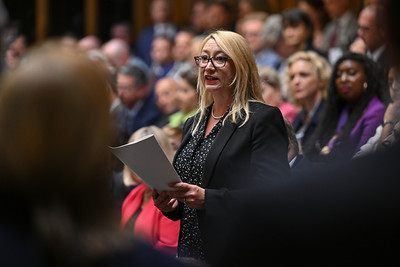
Issues mentioned above are not only relatable to Muslim minorities, but also Christian minorities who face a well organised persecution, quiet and discreet in its proceedings. Christians amount to 2.3% which may have arguably made it easier for Christian persecution be harder to access, as Fiona Bruce mentions in a Parliament debate since it is easy to cover up. However, on a national level, this has created tensions in Christian communities. A close look in the Manipur violence and protests provides us with difficult realisations.
Fiona Bruce mentions that “Hundreds of churches and homes have been burnt, women have been sexually abused and organised mobs attack with impunity, allegedly using looted Government weapons.” The conflict between the Kuki and the Meitei tribes has resulted in the death of 260 people unfortunately, and 60,000 people have been displaced, about at least 10,000 of them children.
Undeniably, these protests and violence also have impacts on the Hindus who are common people who do not hold hate towards their different neighbours. The Meitei tribe which consists majorly of Hindus has been troubled by the Manipur violence, many displaced, wanting to go back home in Churachandpur. Yet the government gives uncertain answers, one such example of PM Modi announced that homes have been built in appropriate locations, without giving any other details.
Going in further detail reveals the recent law adopted by many states which seems to target minorities, especially Christian minorities than any other. This is the Prohibition of Unlawful Anti Conversion Act, and although on face value we may understand that it reflects secularism in it’s goodwill to tackle forceful conversions, it is in reality mostly used by extremists to frame Christian conversions as unlawful and to arrest the priests. This has resulted in more of a religious divide ever, with Christian fearing their life, and praying in secrecy. Archbishop Machado argues the laws were clearly aimed at Christians which could be related to the fact that the Dalits (untouchables- lowest class) in Hindu society.
During the current ongoing tensions between the religious groups, many innocent people suffer, losing their homes, livelihoods and loved ones, and this suffering and loss happens on both sides of the conflict. It is crucial that these groups know that the they are simply fighting people who are much more similar to them than the babas, the priests and the imams who spew hatred against the other. People must realise that while they are fighting within themselves, yet another one in office steals billions which could have been used to aid several homeless people, the disadvantaged and the underpaid. Hatred only ever benefits everyone apart from the common man, and its consequences only ever results in the blood of good, working-class people who only wish for a stable life for their families.
.svg)
Tuba Ahmed is a first-year law student with academic interests in politics, theology, and legal theory. She writes analytical pieces on political and legal issues and is interested in work at the intersection of law and public discourse. Outside her studies, she engages with different cultures and writes novels for herself.
.svg)




.svg)
.svg)