

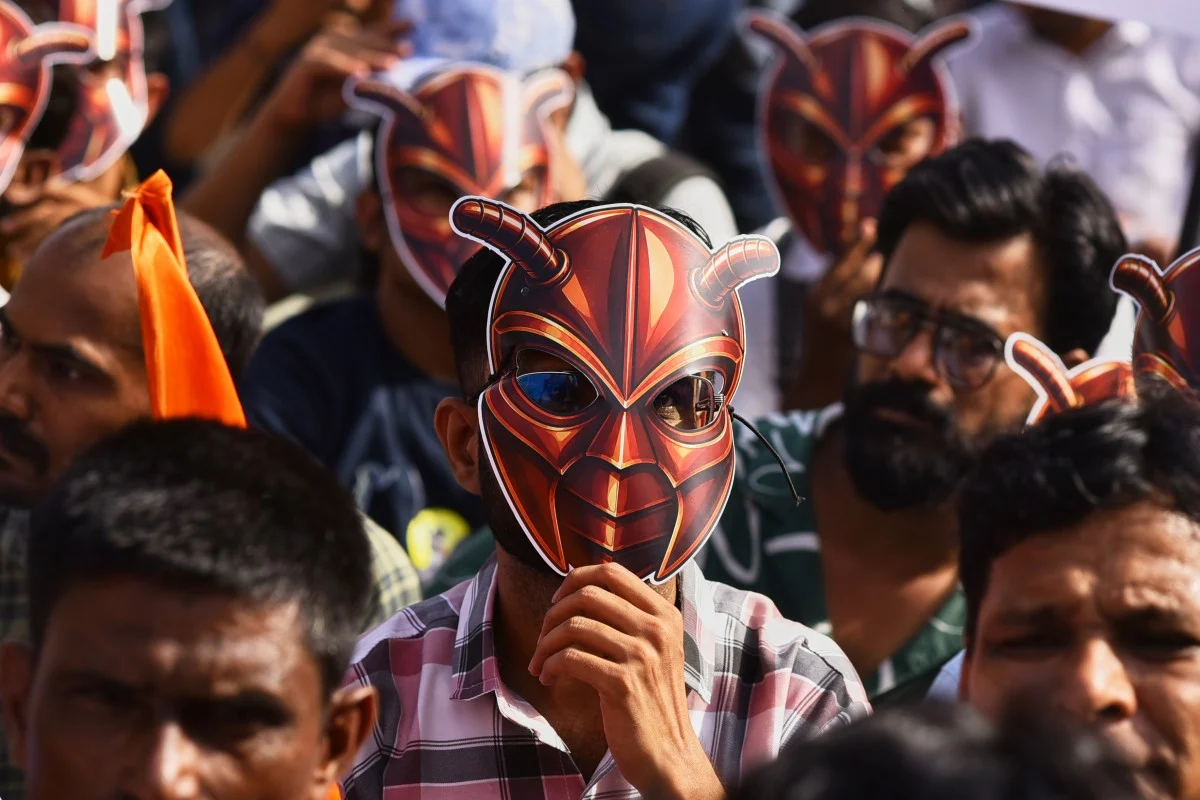
What began as a satirical online jab at India’s political and judicial elite has rapidly evolved into one of the most potent youth-led protest movements in modern Indian history. The “Cockroach Janata Party” (in protest of the “Bharatiya Janata Party” one of the two largest Indian political parties alongside the Indian National Congress) is no longer just an online meme driven by India’s unemployed youth. It has rapidly grown to be a symbol of importance for youth participation in societal decision-making, challenging the status quo with organised protesting, online propaganda, and a clear agenda against current right-wing politics, marking a new era of sociopolitical mobilisation for Gen Z Indians.
The movement’s name stems from a May 2026 remark by India’s Chief Justice Surya Kant, who during a Supreme Court hearing likened certain unemployed youth to “cockroaches” who “don’t get any employment or have any place in profession.” Though later clarified as targeting individuals with forged degrees, the comment ignited widespread outrage among India’s underemployed youth scrambling for limited seats in an oversaturated job market. In a country where nearly 40% of graduates aged 15–25 are unemployed and where test scores are the only proof of a successful future, Kant’s remark towards an already discouraged youth distilled years of systemic frustration into a single, dehumanizing metaphor that millions of young Indians felt personally targeted by. The remark was especially incendiary because it came from the head of the judiciary - an institution defined as the cornerstone of upholding human dignity and constitutional rights - yet it framed an entire generation as “pests” and “media-hungry parasites” rather than citizens with legitimate grievances.
Abhijeet Dipke, a Boston University graduate and former political communications strategist with the Aam Aadmi Party, was particularly enraged by Kant’s comment and was hence motivated to launch the satirical “Cockroach Janta Party”, using social media to rally up concerns amongst India’s youth regarding corruptions in India’s educational, political, and occupational systems. Within days, the CJP’s Instagram account amassed over 20 million followers, surpassing even the Bharatiya Janata Party (BJP) and the Indian National Congress on the platform.
By early June 2026, Dipke returned to India from the U.S. to lead more physical protests, beginning with a rally at Delhi’s Jantar Mantar monument demanding the resignation of Education Minister Dharmendra Pradhan over exam paper leaks of the NEET —India’s mandatory national-level examination for admission to undergraduate medical and dental programs. These leaks have had devastating consequences, including student suicides linked to the immense pressure of India’s high-stakes examination system and stress concerning the brutal 24/7 study “grind culture”.
Youth protesters have brought items like baby diapers to public rallies outside the Parliament to demonstrate the government’s failure to “stop the leaks”. Streets have been lit by candles in memory of students who died by suicide under educational pressure. These protests symbolise how Indian society is not only becoming more economically divided, but also mentally divided concerning issues around student rights, entrance examinations, and restricted educational liberty to pursue personal interests.
Furthermore, the CJP’s five-point “manifesto” calls for systemic reforms in education, employment, and accountability, echoing broader frustrations with the Modi administration. Its demands include the removal of the federal education minister, transparent investigation of exam leaks, and broader structural changes to address youth unemployment and institutional corruption. As of yesterday, PM Modi has acknowledged the five-point manifesto concerns and has promised that “more strict” action would be taken against examination leaks over the irregularities in the NEET-UG 2026 examination. Further actions concerning Modi’s proposal to set up “Fast Track courts” to jail NEET leakers is still under scrutiny by the Cabinet; there will be more clarity by the next Parliament session on Monday.
The CJP’s unprecedented rise in popularity has drawn both support and suspicion. Opposition figures, including Samajwadi Party’s Akhilesh Yadav and Trinamool Congress MPs Mahua Moitra and Kirti Azad, have publicly endorsed the movement. Meanwhile, government allies have dismissed it as a front for opposition parties, with some even labeling it the “B-team of terror groups” - a claim that Dipke firmly rejects. The Indian government has also moved to curb the CJP’s digital presence. Its X (formerly Twitter) account was withheld within five days of creation, and Dipke has alleged hacking attempts and death threats against him and his family. Despite such opposition, the movement continues to grow, with plans to establish a formal organizational structure across multiple states.
The CJP’s emergence signals a shift in how political dissent is organized in India. Unlike traditional parties, it operates through decentralized networks, meme culture, and grassroots mobilization. It’ leaders are young leaders ranging from teens to recent graduates, who understand the power of viral social media content and symbolic protest. This poses a challenge to the traditional political structure that has shaped India since 1947. The BJP, in particular, has struggled to connect with Gen Z voters, who increasingly view the party as out of touch with their economic and social realities. Hence, the CJP’s satirical yet substantive critique offers a fresh criticism towards current party structures, becoming a voice for a generation that feels politically orphaned.
Moreover, the movement highlights the limits of India’s democratic institutions. If the judiciary, executive, and electoral systems fail to address youth grievances, alternative forms of political expression emerge. The CJP is not seeking to replace existing parties but to hold them accountable for their tendency to marginalise youth from politics — a role that traditional opposition parties have largely failed to fulfill.
India is finally seeing the youth creep up to dismantle traditional political institutions. In a country where youth make up an undeniably significant proportion of the population, the CJP offers hope to the “cockroaches” of society to protest against the persistent gerontocracy, high youth unemployment, and outdated political systems.
.svg)
Shreya is a student with an interest in world politics, legal ethics, technology law, and jurisprudence. She hopes to study law at university and is passionate about the critical human decisions that shape the world around us. She is especially interested in exploring how artificial intelligence will modify legal theory, judicial decision-making, and procedural fairness, a field that continues to gain prominence in modern society.
.svg)



.svg)
.svg)
.jpg)