
Image - SecretName101
January 20th 2026 marked 1 year into Trump’s 2nd term of presidency. From immigration enforcement to international kidnapping, Trump’s return to office has left spectators speechless like never before. Although it would be impossible to list every event and very utterance originating from the Trump administration that has opened eyes and caused distress thus far, I will do my best to highlight the key points with necessary criticisms.
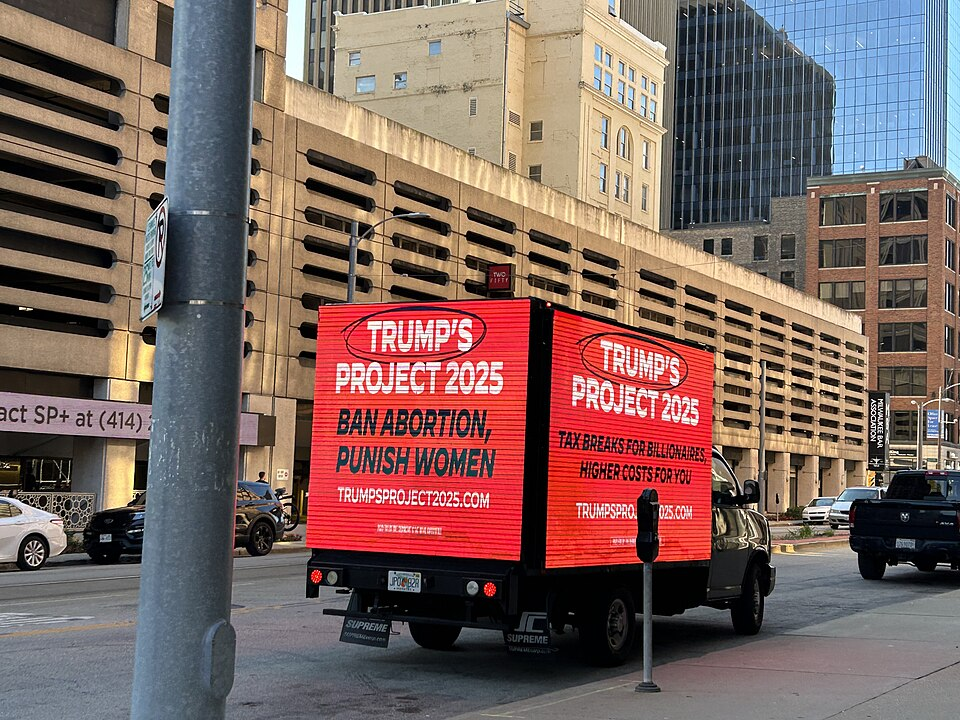
In 2025, Donald Trump signed more executive orders than he did in his entire first term as President. On his very first day as president, he signed 26 executive orders – more than any by a president on their first day, ever. Many of these executive orders reflect a broader ideology encapsulated in ‘Project 2025’. The term, founded by right wing think tank The Heritage Foundation, defines a conservative blueprint for the Trump administration, covering key aspects such rollbacks on LGBT+ and abortion rights, tax cuts for the rich, anti-climate change policies and more general conservative ideals.
Today, around half of Project 2025’s initial aims have been completed, according to evidence from a Project 2025 tracker website. In many areas, his early executive orders were just the beginning. For example, after withdrawing from the Paris Climate Agreement with Executive Order 14162, thus sticking to the anti-climate rhetoric of the project. Trump fired nearly 400 climate change scientists in April 2025, embracing coal whilst pushing renewable energy to the side, and cut funding for a majority of green energy projects.
However, Project 2025 has an even darker side. If destroying the planet as well as the rights of women and LGBT+ individuals was not enough, the project exposes the authoritarian desires of MAGA. A key part of the project is reinstating Schedule F, a procedure created in Trump’s first term with Executive Order 13957 however rescinded by Biden, then brought back again with Executive Order 14171 on Trump’s first day back in office. This scheme allows the easy removal of federal civil servants, and is intended to remove Trump’s critics to instate only loyalists, and thus enables the president to push policies with minimal internal resistance. This is a clear hallmark of authoritarian governance, democracy erosion, and freedoms guaranteed by the 1st Amendment.
The Big Beautiful Bill was Trump’s answer to the socioeconomic proposals in Project 2025. 900 pages long, it was signed into law on July 4th, 2025. The main idea was to create extensions to tax cuts from the 2017 Tax Cuts and Jobs act which were set to expire late 2025, such as permanent tax cuts for the rich, cuts to SNAP benefits and Medicaid, and increased spending on defence, border security and immigration.
However, the bill isn’t as beautiful as it seems. According to data from the PEW Research Centre, nearly half of all Americans (49%) oppose the bill, and only around 56% of Republicans supported it. Republicans such as Thomas Massie and Warren Davidson voted against the bill on fiscal grounds. Others such as Thom Tillis delivered a forceful floor speech criticising parts of the legislation, notably stating “It is inescapable this bill will betray the promise Donald Trump made” and “What do I tell 663,000 people in two years, three years, when President Trump breaks his promise by pushing them off of Medicaid because the funding’s not there anymore?”.
The Bill is also largely funded through increased government borrowing, with the Congressional Budget Office (CBO) reporting that the act will add $3.4 trillion to deficits over 10 years. The CBO also report that the number of individuals without health insurance would increase by an estimated 7.8 million by 2034 due to the Medicaid provisions. The act only makes life more difficult for the 69 million Americans (20% of the entire population, based on data from September 2025) enrolled in Medicaid.
Trump ramped up the use of Immigration and Customs Enforcement (ICE) with Executive Order 14159. It was clearly detailed on page 143 of Project 2025, which stated the desire to increase capacity of ICE detention facilities by 100,000 beds daily, clearly setting up his intentions of the force. The order gave officers much more power to aggressively enforce immigration law against all unauthorized immigrants.
In August 2025, ICE rolled out a major recruitment campaign offering signing bonuses of as much as $50,000 for new recruits, along with other benefits such as student loan repayment and overtime opportunities. They also reduced the minimum signup age from 21 to 18. Subsequently, based on data from the Department of Homeland Security, US immigration enforcement officials arrested more people in the first 22 days of February 2025 than in any month over the last seven years.
The brutality of these enforcement methods is what stands out in the case of ICE. In 2025, ICE methods included dragging people out of cars, smashing windows, and allegedly zip-typing children whilst separating them from their parents. Their looks-based attacks leads to racial profiling, unnecessary harassment to POCs, and unjust arrests to American citizens simply due to their race: this is reflected by A ProPublica headline 'We Found That More Than 170 U.S. Citizens Have Been Held by Immigration Agents. They’ve Been Kicked, Dragged and Detained for Days'. This is followed by a short subheading detailing how an American man was detained despite telling the officers he was a citizen, simply because he was Latino. Their shocking brutality has led to the unnecessary killings of American citizens, such as Renee Nicole Good and Alex Pretti. In many cases, the conditions of ICE processing facilities are also disgusting and inhumane: for example, the Broadview ICE Processing Facility near Chicago was sued in late 2025, for horrific conditions including overcrowding, filthy cells, lack of proper sleeping arrangements, and limited access to showers or personal hygiene products.
During the 2024 election campaign, Trump vowed to end the Russian war on Ukraine “in 24 hours.” In 2025, that unsurprisingly didn’t happen, and he has been in hot water regarding his actions towards the conflict. Early in his presidency, Trump repeatedly questioned the effectiveness of U.S. military aid, suggesting that continued arms shipments to Ukraine were costly and may not change the outcome of the war. This led to a meeting on February 28 with Volodymyr Zelenkyy, President of Ukraine, to discuss the ongoing war with Russia and efforts for Ukraine’s rare earth and critical mineral resources in return for US support. What followed was a meeting that made the world cringe in horror and embarrassment at Donald Trump and JD Vance's actions.
Trump repeatedly criticised Zelenskyy for ‘not being thankful enough’, with Vice President J.D Vance asking whether Zelenskyy had ‘said thank you once’, ridiculing him for not wearing a suit (despite his choice to wear military-style clothing to symbolise solidarity with Ukrainian soldiers) and Trump’s blunt, aggressively toned comments such as “You’re not in a good position … you’re gambling with World War III.”
Shortly after the meeting, Trump stated on Truth Social that Zelenskyy had ‘disrespected the United States of America’, and the White House announced a review and “pause” on assistance to Ukraine. Their next formal meeting wasn’t until August 18th, which was part of a broader multilateral meeting containing many other European leaders. The meeting was much more productive, with Trump indicating the United States was considering providing strong security guarantees for Ukraine as part of a peace settlement. However, although Trump spoke about aiming for peace, he suggested he did not think an immediate cease fire was necessary, drawing upon past deals he had negotiated without ceasefires: a view that diverged from what the European leaders and Ukraine favour, seemingly downplaying the killings of innocent civilians.
Mid to late 2025 saw extreme actions taken by the Trump administration towards Nicolás Maduro, former President of Venezuela. In July, the U.S. Treasury Department officially tied Maduro to the drug trafficking gang Cartel de Los Soles, labelling them as “narco-terrorists”. A few weeks later, he doubled the reward for Maduro’s capture to $50 million.
By September, the U.S had begun what was later named ‘Operation Southern Spear’: a large-scale military campaign against criminal maritime networks. On September 2nd, Trump ordered the killing of 11 people in a boat off the coast of Venezuela, claiming they were drug dealers tied to the Tren de Aragua criminal group – although there was never a formal trial to consolidate these links. In October, Trump authorised the CIA to conduct operations inside Venezuela, and by December, was conducting drone strikes on them. These actions constitute to extreme constitutional violations, especially against Article 1 Section 8 Clause 11 which states that ‘The Congress shall have Power To declare War .. and make Rules concerning Captures on Land and Water’, something that was entirely done by Trump, and not Congress.
However, things took the biggest turn in the new year. On January 3rd 2026, in a major escalation, U.S. forces launched a large military operation where President Nicolás Maduro and his wife Cilia Flores were captured by U.S. forces and flown out of the country. The Trump administration began seizing Venezuelan-linked oil tankers as part of an oil blockade campaign, claiming they were violating U.S. sanctions or transported illegally. As of Jan. 20, seven tankers have been seized.
Many spectators link the administration’s entire military efforts to stealing Venezuela’s oil, and dismiss the claim of tackling drug trafficking as an excuse. Venezuela is not a major source of the drugs killing Americans: fentanyl (the biggest crisis) mainly comes via Mexico and China. Venezuela has the largest proven oil reserves in the world, estimated at over 300 billion barrels, mainly in the Orinoco Belt. For decades, U.S. companies were deeply involved in Venezuelan oil, however, under Chávez and Maduro, oil was nationalised and sanctioned, and U.S. access shrank. The illegal invasion of Venezuela means the US now has access to billions of dollar’s worth of Venezuelan oil.
Formally acquiring Greenland has long been on Trumps radar: his interest began during his first term in 2018 yet was revived in 2025. Its geographic position – between North America, Europe and the Arctic, makes it a key location for U.S defence and surveillance, particularly against Russia. Greenland also has rare earth minerals, such as Uranium and Iron ore, that would help reduce mineral dependence on China.
The first formal meeting occurred between U.S, Danish, and Greenland officials occurred on January 14th 2026; resulting in Greenland and Denmark reiterating their stance of ‘our home is not for sale’ that was seen first during the first Trump administration. Greenland is owned by Denmark, however with self-determination granted by their Self-Determination and Self-Government Act (2009) - which prevents the sale of Greenland without a referendum. Ignoring this, Trump threatened 10% tarrifs on European allies (set to rise to 25% on June 1 if no deal had still been reached) until these allies agreed to his plan of taking over Greenland. This highly coercive move has been extremely scrutinised, including strongly by Keir Starmer.
However, at a major address to the nation at the World Economic Forum in Davos, Switzerland on January 21st, he reversed these plans and announced that he and NATO officials had agreed a “framework of a deal”. Although we do not know what it contains, it is extremely unlikely to include legal sovereignty of Greenland due to the stance of Greenland itself, Greenlandic laws, and European allies firmly blocking the idea of U.S ownership.
Despite Trump’s attempts to downscale it, Trump’s past friendship with notorious paedophile Jeffery Epstein is widely known. The internet is full of images of them partying in the 90’s, with Trump also stating in a 2002 interview with New York Magazine that Epstein was a “terrific guy” and “liked beautiful women as much as [he does], and many of them are on the younger side”. These words are enough to make many believe that Trump appears in the files, potentially along with details that may expose him committing rape or paedophilia. His stance to not release them also furthered these thoughts. He repeatedly called the files a ‘hoax’, and despite calls from his own side to release them, he refused to do so until November, when pressures finally gave in. Many saw this reluctance as ‘protecting’ Jeffery Epstein and his clientele. In the words of Trump’s own son, ‘Why would anyone protect those scumbags?’.
On November 19, Trump finally signed the Epstein Files Transparency Act into law, and the ‘Epstein Files’, mostly including hundreds of pages of black lines covering the reality of the document were released a month later. The DOJ later admitted it could not meet the disclosure deadline, and as of January 2026, the DOJ has released less than 1% of the responsive documents despite the law’s mandate. The only notable detail is solid evidence that Trump appeared on Epstein’s private jet at least 8 times between 1993 and 1996, something that Trump previously denied. Whether we will ever get an unredacted version of the Epstein Files, or one that is not simply laughable at its blatant protection of Donald Trump and co, is currently unknown.
Donald Trump’s first year back in office has left not only the United States but the entire world scared and in widespread discontent. Most independent polls show current approval ratings in the low 40s or high 30s (Emerson Polling - 43%, NY Times – 40%, YouGov – 37%) – figures that show more Americans disapprove than approve of his presidency so far.
American’s have voiced discontent in 2 ‘No Kings’ protests: with the name derived from Trump’s authoritarian-style rule, it is clear what many Americans thought of Trump’s first year in office. Trump’s response to the protest, however, once again indicated his childish and dictatorial stance; instead of listening to the protestor’s views, he posted an AI video of himself dumping faeces onto the protestors.
After such an eventful and catastrophic first year back, once can only imagine what the next 3 years holds for the US. Will he continue to erode democracy and basic human rights, violate national and international law entirely, protect notorious paedophiles, and present the United States as a laughing stock to the rest of the world?
.svg)
Lara is a Politics student at the University of Leeds. She is specifically interested in USA and Global politics. Elsewhere, she enjoys baking and watching football.
.svg)



.svg)
.svg)