
Image - Fabio Fistarol
It has been one year since Chicago-born Robert Francis Prevost became Pope Leo XIV, and in that time, the American Pontiff has seen both sides of the Trump coin. A ‘great honor’ for the United States were the words of the US President in response to the results of the May 2025 Conclave, expressing his desire to meet with the new Pope. However, all it took was a year and the Holy Father’s refusal to blindly follow MAGA positions on the war in Iran for President Trump do a full 180 degree turn on his stance to Pope Leo XIV. Realistically, how can the US President maintain good relations with a Pope who is ‘too liberal, ‘weak on crime’, and ‘terrible for foreign policy’, and what does this rift with the Vatican mean for America, the Holy See, and the 1.4 billion Catholics who look to the Supreme Pontiff as their spiritual leader?
The first of his kind
Cardinal Prevost’s election to the Papacy took to world by surprise. Some factors played against him: he was barely considered papabile, or a likely candidate for the office, making him a dark horse, and he was only made a cardinal in 2023. What was his biggest challenge, however, was his American nationality. In the US’ nearly 250-year history, not once has one of their own ascended to the Papacy, and the reason for this is clear: America is a global superpower, with an image that, as John Carroll, professor of theology at the University of Ohio puts it, ‘simply is too powerful – and to be blunt, ugly’.
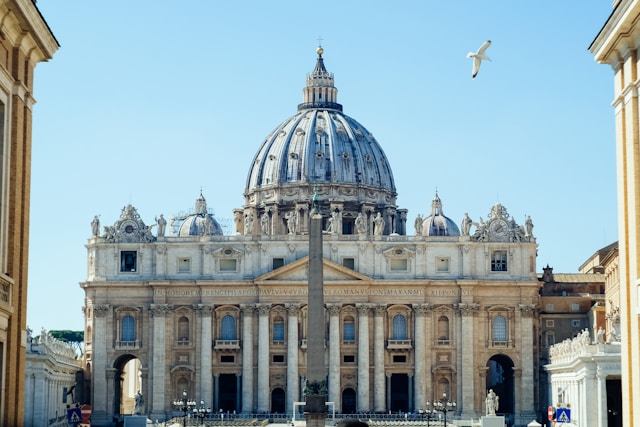
But after just two days and four ballots in the Sistine Chapel, out onto the Central Loggia of St. Peter’s Basilica stepped the new American Bishop of Rome, though in very different fashion to his predecessor. Unlike the late Pope Francis, who, after his election in March 2013 greeted the world in just a very simple white cassock, Pope Leo XIV delivered his Urbi et Orbi blessing in the traditional papal red pellegrina, red and golden stole, and an ornate gold and silver pectoral cross. The symbolism here was unmistakable: the Pontiff reminded the world, through his attire, of both his spiritual authority as the head of the Catholic Church, and of his political authority as sovereign of the Holy See and the Vatican City State.
Bringing back these symbols of authority, some speculated that the new Pontiff, combined with his American nationality, would lean conservative, perhaps even fitting the MAGA narrative of the US administration, which rejoiced at his election, with both President Trump and Vice President Vance emphasising their joy and desire to future cooperation with the Holy See and, by extension, the Catholic Church.
Conflicting agendas
This assumption of conservatism was soon flipped on its head, when the US Administration was reminded of the role of the Roman Pontiff. Pope Leo XIV is a politician, undoubtedly, but he is a politician in a very different sense to the US President. His role is primarily spiritual, and one which transcends political lines, nations, and borders. The Pope has an obligation which is principally moral supranational: he is a universalist and a shepherd for the universal church, and by virtue of his universalism, he promotes international solidarity and global openness.
There are very limited ways in which this could be any different from the MAGA agenda of Donald Trump. His administration runs on the notion of America-first nationalism and creating massive internal divisions on polarising issues which the Administration perceive as threats to American sovereignty and identity.
The rift between the Holy See and the US first becomes visible when comparing stances on immigration. The Pope has taken a very sensible position on the issue, emphasising the dangers that polarisation through hardline nationalism can create, while also respecting national sovereignty when it comes to decision-making on migration policy, stating that ‘every country has the right to determine who enters, how, and when’. The Pontiff has also been critical of ICE and has expressed concern regarding the treatment of detainees, therefore any rumours that the Pope is a puppet of the US Administration can be dispelled, which would later be cause even greater challenges between the two world leaders.
The real rift came when the Pontiff made remarks in relation to Trump’s 2026 attacks on Iran. In a Palm Sunday homily, Pope Leo XIV preached that ‘Jesus does not listen to the prayers of those who wage war’, which he then followed up in Easter Sunday with a call to ‘let those who have the power to unleash wars choose peace! Not a peace imposed by force, but through dialogue’. It is therefore clear that the position of the Holy See on this war is starkly negative and is fuelled by a ‘delusion of omnipotence’.
It did not take long for Trump to hit back at the Pontiff, calling him ‘very liberal’ and ‘catering to the radical left’, going so far as to call him illegitimate and an American counterweight to him, posting an AI-generated image of himself as Jesus onto Truth Social. In keeping with his diplomatic nature, the Pope dismissed the words of the President, reminding the world that he is first and foremost a preacher of the Gospel. This feud between the Vatican and the US administration has received heavy criticism from many religious groups within the US, as well as on the global stage, with Italian Premier Giorgia Meloni expressing her support for the Pope and terming the attacks from the US President as ‘unacceptable’. In true Trump fashion, Meloni was next on the chopping block for criticism.
A crisis of authority
This tension between the Papacy and the US Administration is quite unprecedented and shows that the rift goes deeper than policy disagreement. It must be borne in mind that Pope Leo XIV’s views on the Iran war come from his background as an Augustinian, whose founder, St. Augustine of Hippo, pioneered the just war theory. As the former Prior General of the Order of Saint Augustine, Pope Leo XIV is certainly a trustworthy authority on questions about whether a conflict is just or not.
Here is where this rift goes deeper, showing how American nationalism questions moral doctrine when it comes into conflict with political ideology. US Vice President JD Vance commented that the Pope should ‘be careful’ when discussing matters of theology. This goes beyond routine political disagreement and is unusual from a conservative Catholic, who historically are the first to defend the Pope’s authority. More concerning, however, is how this challenges role of the Pope itself. As the visible head of the Catholic Church, one of the Pope’s key mandates is to be the supreme spiritual authority on matters of Catholic theology and doctrine. This role is so important, in fact, that the Pope cannot even be wrong about matters of theology. This is by virtue of the Doctrine of Papal Infallibility.
This issue is stronger than whether the Pope can be challenged or not but rather brings into question what happens when political identity becomes stronger than religious authority. This dispute reflects something larger than a disagreement over the handling of the War in Iran: it is telling of the fact that for some MAGA supporters, political ideology is more important to them than religion. The irony of this is, that this is the same movement which pushes “Christian values” in a “Christian civilisation”. Perhaps this also a reflection of the “pick and choose” attitudes of the MAGA Americans who will always stand behind the Church when they hear something they like but then question it once it clashes with their nationalist priorities.
In this sense, the rift between Trump’s US and Pope Leo XIV’s Vatican is more than a clash of two leaders and more than a disagreement on policy, but is instead a question of authority, both in political and moral senses, and how that authority should present itself in the broader system of American politics.
What’s next for Trump’s war with the Vatican?
We’ve seen the US Administration’s reactiveness and often impulsive responses to the Holy See’s stance on global affairs, but this cannot be the end of the story. The Vatican cannot simply be ignored, and fighting the Pope is not like arguing with the media, academic institutions, or even the courts, which President Trump has so often done. It is different because Trump’s authority is purely political, derived from popular sovereignty, while the Pope’s is very different: the Pope exercises authority through his moral legitimacy as the shepherd of 1.4 billion Catholics across all inhabited continents. This is an authority structure which Trump simply cannot dominate, and that is part of the reason why he is so eager to challenge the Pontiff.
The Vatican is one of very few institutions in the world whose authority cannot easily be reduced to elections, opinion polling, and party approval. This is completely antithetical to populism, under which the MAGA movement falls. Where this becomes troubling for the future is that political identity is perceived as more powerful than religious identity, and institutions like the Holy See, which have historically been viewed as morally authoritative, are being judged through partisan lenses. This could signify a gradual erosion of shared authority which shapes the identity of the sensible voter, whereby these people feel forced to choose either to follow their political ideology or their religious identity to shape how they see the world. The trouble is, it becomes a question of extremes with absolutely no room for a middle ground, according to their perception.
Clash of the titans
There is absolutely no question here, nor should there be, that Trump possesses immense political power both domestically and abroad, and the same is true of the Pontiff. The difference here is what that power represents: Pope Leo XIV represents an institution which measures its influence in spiritual and moral terms. Therefore, this “soft war” is not a battle over policy, but rather is a struggle over legitimacy, authority, and who has the right to define the moral foundations behind decision-making in today’s political background.
.svg)
Max is a student of Law and German at the University of Bristol. He is most interested in the workings of institutions and accountability, as well as constitutional and administrative law, and international politics.
.svg)
.svg)
.svg)
.jpg)